









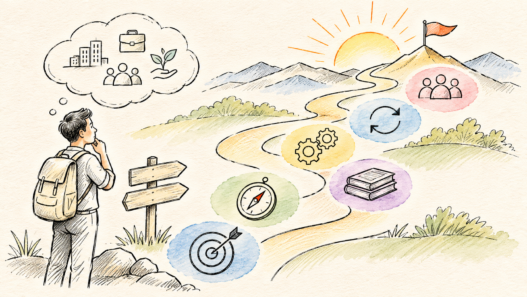




Transformation often requires us to surrender the familiar before we can fully understand what lies ahead. Learning to navigate this uncertainty is essential to purposeful personal and professional growth.
There comes a point in life when the circumstances that once contributed to our growth begin to limit it.
A career that once excited us becomes a routine we endure. A professional environment that once challenged us no longer stimulates our intellectual curiosity. The ambitions we once pursued with enthusiasm gradually become overshadowed by our desire for stability.
Yet, despite recognizing that something needs to change, we remain where we are.
Not necessarily because we are satisfied, but because the familiarity of our present circumstances feels safer than the uncertainty of our future.
Change can be painful. However, remaining in an environment that no longer supports our growth can carry an even greater cost.
Consider the transformation of a caterpillar into a butterfly. During its time within the chrysalis, an extraordinary biological transformation takes place. What appears externally to be a period of inactivity is, in reality, a period of profound development.
The caterpillar cannot retain its existing form and simultaneously become a butterfly.
There is a powerful lesson in this metaphor: sometimes, becoming who we aspire to be requires us to relinquish aspects of who we have been.
Why We Resist Change
Human beings often develop a psychological attachment to familiarity. Established routines, predictable environments and recognizable responsibilities provide a sense of security.
Even when our circumstances are less than ideal, knowing what to expect can feel more manageable than confronting the unknown.
This tendency can become particularly evident in our professional lives.
An individual may remain in an unfulfilling role because they fear losing financial stability. Another may avoid pursuing a leadership position because they question their ability to manage greater responsibilities. Someone else may hesitate to enter a new industry because doing so would require them to become a beginner again.
These concerns are not necessarily irrational. Change involves genuine risks, and responsible decision-making requires us to acknowledge them.
However, we must also recognize that remaining unchanged carries risks of its own.
Industries evolve. Technologies advance. Organizational priorities shift. Skills that were once highly valued may gradually become less relevant.
The professional who refuses to adapt may eventually discover that the stability they were attempting to preserve was more temporary than they imagined.
The question, therefore, is not simply whether change is risky.
It is whether the risks associated with remaining where you are outweigh the risks associated with moving forward.
Recognizing When You Have Outgrown Your Current Circumstances
Not every difficult season requires a dramatic life change. Sometimes, what we need is rest, a renewed perspective or a different approach to our existing responsibilities.
However, there are circumstances in which persistent dissatisfaction deserves deeper examination.
You may have outgrown your current professional environment if:
- You are no longer acquiring meaningful knowledge or developing new capabilities.
- Your responsibilities consistently fail to challenge your potential.
- Your professional values increasingly conflict with those of your organization.
- You find yourself repeatedly postponing ambitions that remain important to you.
- Your primary motivation for staying is fear rather than genuine fulfilment.
- You can no longer identify a realistic path towards the future you envision.
These indicators should not automatically prompt resignation or an immediate career transition. Instead, they should encourage honest reflection.
Sometimes, meaningful change can occur within your current organization through new responsibilities, mentorship, professional development or a different role.
At other times, transformation may require an entirely different environment.
The important thing is to make that determination intentionally rather than allowing inertia to make it for you.
Seven Strategies for Embracing Change and Accelerating Career Growth
1. Reframe Your Relationship with Discomfort
Discomfort is frequently interpreted as a warning that something is wrong.
Yet learning a new skill, accepting greater responsibility and entering unfamiliar environments can all generate discomfort, even when these experiences are beneficial.
Imagine a professional who has spent years developing technical expertise and is subsequently offered a leadership position.
The transition may require them to navigate interpersonal conflict, make difficult decisions and communicate with greater confidence. Their initial discomfort does not necessarily indicate that they are unsuitable for leadership. It may simply reflect the demands of developing unfamiliar capabilities.
Rather than immediately retreating from discomfort, examine its source.
Is it a consequence of learning something new? Is it revealing an area in which you need additional support? Or is it an indication that your environment is genuinely harmful?
This distinction matters.
Growth-related discomfort can be valuable, but enduring mistreatment, chronic exhaustion or an unhealthy workplace should not be mistaken for personal development.
The objective is not to become comfortable with suffering. It is to become more capable of navigating the uncertainty that accompanies meaningful progress.
2. Invest in Skills That Expand Your Options
One of the most effective ways to reduce the fear associated with professional change is to increase your preparedness for it.
When your capabilities are limited to a particular role or organization, the prospect of leaving that environment can feel especially intimidating.
Developing transferable skills expands the range of opportunities available to you.
Communication, leadership, strategic thinking, digital literacy, project management and financial understanding are examples of capabilities that can create value across multiple industries.
Rather than pursuing professional development indiscriminately, begin with the future you envision.
Identify several positions or career paths that interest you. Examine the qualifications, competencies and experiences commonly associated with them. Compare these requirements with your existing capabilities.
Where are the gaps?
Use this information to establish a targeted learning strategy.
A certification, course or professional development programme becomes considerably more valuable when it serves a clearly defined objective.
Do not merely accumulate credentials. Develop capabilities that increase your freedom to choose.
3. Expand Your Network Beyond Your Familiar Environment
Our understanding of what is possible is often influenced by the people with whom we regularly interact.
When our professional relationships are concentrated within a single organization, industry or area of expertise, our awareness of alternative opportunities may become unnecessarily restricted.
Expanding your network exposes you to different career trajectories, emerging industries and unfamiliar approaches to professional success.
Consider connecting with individuals who have successfully navigated transitions similar to those you are contemplating.
Ask them about the challenges they encountered, the skills they needed to develop and the decisions that proved particularly valuable.
Their experiences may help you identify opportunities and risks that you had not previously considered.
Networking should also involve more than seeking assistance. Approach these relationships with genuine curiosity and a willingness to contribute.
Meaningful connections can provide encouragement, knowledge and access to opportunities, but their greatest value may be their ability to expand your perspective.
4. Develop a More Constructive Relationship with Failure
Fear of failure is one of the most significant obstacles to professional transformation.
We may avoid applying for a position because we anticipate rejection. We may hesitate to present an innovative idea because we fear criticism. We may abandon an entrepreneurial ambition because we are uncomfortable with the possibility that it might not succeed.
In attempting to protect ourselves from disappointment, we can inadvertently protect ourselves from opportunity.
Failure is not inherently beneficial. Its value depends largely on how we respond to it.
An unsuccessful interview, for example, can become an opportunity to evaluate how effectively we communicate our experience. A project that does not achieve its intended objectives can reveal weaknesses in planning, execution or collaboration.
After a professional setback, consider reflecting on the following questions:
- What was I attempting to achieve?
- Which factors were within my control?
- What assumptions did I make that proved inaccurate?
- What would I approach differently next time?
- What knowledge or support would improve my future performance?
This process transforms disappointment into information that can inform subsequent decisions.
Not every rejection contains a personal lesson, and not every unsuccessful outcome reflects a deficiency in your abilities.
Nevertheless, developing the capacity to evaluate setbacks without allowing them to define your identity is an important aspect of professional maturity.
5. Seek Feedback That Challenges Your Self-Perception
Personal growth requires a willingness to acknowledge that our understanding of ourselves may be incomplete.
We all have blind spots: behaviours, habits and limitations that may be more apparent to others than they are to us.
Constructive feedback can help us recognize these areas before they become significant barriers to advancement.
Rather than waiting for an annual performance evaluation, actively seek insights from individuals whose judgement you respect.
Ask specific questions.
What could I do to become a more effective communicator? Where do you believe I have untapped leadership potential? What habits might be limiting my professional effectiveness?
Specific questions are more likely to generate actionable insights than a general request for feedback.
Equally important is your response.
When feedback challenges your self-perception, the natural inclination may be to defend your intentions or explain your circumstances.
Instead, give yourself time to consider whether there is something valuable within the observation.
You do not have to accept every criticism as accurate. Feedback should be evaluated in light of its source, context and relevance.
However, dismissing every uncomfortable observation can prevent you from recognizing opportunities for improvement.
6. Take Calculated Risks Before You Feel Completely Ready
Many people postpone significant decisions because they are waiting to feel sufficiently confident.
Unfortunately, confidence often develops through experience rather than preceding it.
The professional who waits until they feel entirely prepared for leadership may never accept the responsibilities through which leadership capabilities are developed.
The aspiring entrepreneur who waits until every uncertainty has been eliminated may never test the viability of their business idea.
There is a difference between recklessness and calculated risk-taking.
Calculated risks involve evaluating potential consequences, developing contingency plans and making informed decisions despite incomplete certainty.
You might volunteer to lead a project outside your usual responsibilities. Apply for a position that stretches your existing capabilities. Explore a business concept through a small pilot project before committing substantial financial resources.
These actions allow you to develop experience while managing your exposure to unnecessary risk.
Where financial obligations or family responsibilities are involved, preparation becomes especially important. Building savings, exploring opportunities while employed and developing alternative sources of income may make a transition more manageable.
Courage does not require you to disregard your responsibilities.
It requires you to stop treating uncertainty as an automatic reason for inaction.
7. Remain Anchored in Purpose
Change becomes considerably more difficult when we lack clarity about why we are pursuing it.
Without a meaningful sense of direction, we may find ourselves chasing promotions, higher salaries, prestigious titles or external recognition without considering whether these achievements contribute to the life we genuinely desire.
Purpose provides a framework through which we can evaluate opportunities.
It encourages us to consider not only what we can achieve but also why those achievements matter.
What kind of contribution do you want to make? What values do you want your professional life to reflect? What kind of person do you aspire to become?
These questions become particularly valuable during periods of uncertainty.
For those whose lives are grounded in faith, prayer and reflection can also provide an opportunity to examine whether a particular direction aligns with their convictions and understanding of God’s purpose for their lives.
Faith does not necessarily provide immediate clarity about every decision. However, it can offer the courage to move forward thoughtfully without possessing all the answers.
When your decisions are anchored in purpose, change becomes more than a pursuit of external advancement.
It becomes an expression of intentional living.
Your 30-Day Career Transformation Plan
Meaningful transformation does not always begin with a dramatic decision. It can begin with a structured period of exploration, reflection and deliberate action.
Use the following framework to begin evaluating and expanding your professional possibilities.
| Period | Focus | Practical actions |
|---|---|---|
| Days 1–7 | Self-assessment | Identify your strengths, sources of dissatisfaction, professional values and long-term aspirations. |
| Days 8–14 | Capability development | Research three potential career paths, identify skill gaps and begin a targeted learning activity. |
| Days 15–21 | Connection and feedback | Arrange two informational conversations and request constructive feedback from a trusted professional. |
| Days 22–30 | Strategic action | Apply for a challenging opportunity, propose a new initiative or develop a realistic career transition plan. |
At the end of the thirty days, evaluate what you have discovered.
Has your understanding of your current circumstances changed? Have you identified opportunities that you had previously overlooked? Are your concerns about change supported by evidence, or are some of them rooted primarily in fear?
You do not need to have transformed your entire career within a month.
The objective is to replace passive dissatisfaction with informed, purposeful action.
When Growth Requires Letting Go
One of the less frequently discussed aspects of transformation is the sense of loss that can accompany it.
Moving into a new professional chapter may require leaving behind familiar colleagues, established routines, a respected position or an identity that has taken years to develop.
Even positive changes can involve grief.
An individual who leaves a long-standing career to pursue a different calling may experience excitement about the future while simultaneously mourning the familiarity of the past.
These emotions can coexist.
Acknowledging what you are leaving behind does not diminish the significance of what you are moving towards.
You can appreciate an organization that contributed to your development without remaining there indefinitely. You can be grateful for a previous chapter without allowing it to determine the boundaries of your future.
Some environments are valuable precisely because they prepare us for opportunities beyond them.
Recognizing when that preparation has served its purpose is an important part of growth.
Give Yourself Permission to Evolve
The transformation of a caterpillar reminds us that what appears to be an ending may also represent the beginning of something entirely different.
Human transformation, unlike biological metamorphosis, is neither automatic nor guaranteed. It requires awareness, decisions, effort and, often, the support of others.
There will be moments when progress feels uncomfortable. There will be decisions that challenge your confidence and experiences that require you to reconsider your understanding of yourself.
But familiarity alone is not a sufficient reason to remain unchanged.
Continue learning. Remain receptive to constructive feedback. Build meaningful relationships. Take thoughtful risks and allow your sense of purpose to guide your decisions.
You do not have to abandon everything you have built to embrace a new chapter. Sometimes, transformation involves carrying the wisdom of your past into a future that demands more of your potential.
The life you aspire to live may require capabilities, perspectives and decisions that you have yet to develop.
Give yourself permission to develop them.
Do not sacrifice the possibilities of your future simply to preserve the familiarity of your present.